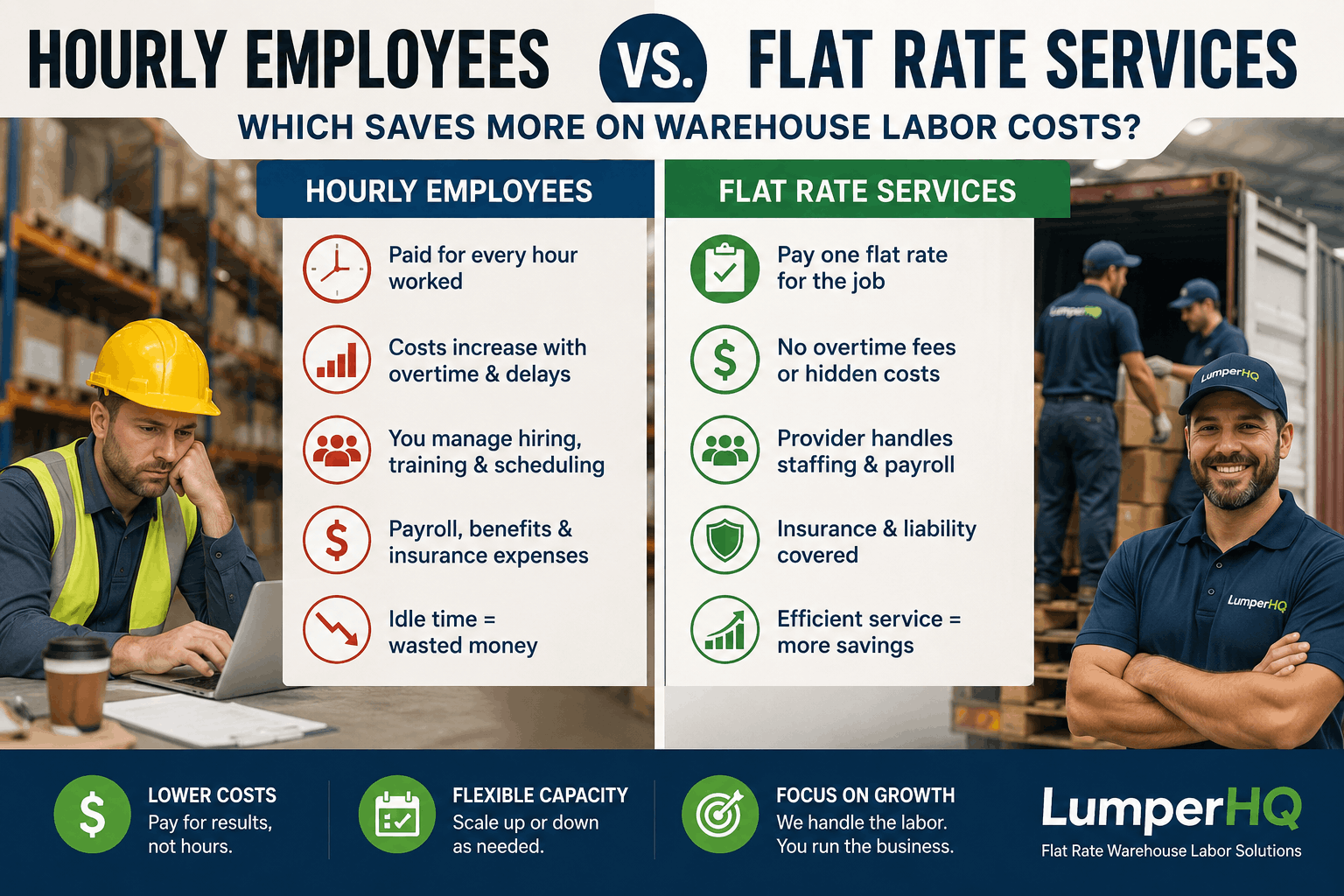
Hourly Warehouse Employees vs. Flat-Rate Warehouse Services: Which Saves More Money?
For warehouse operators, controlling labor costs is one of the biggest challenges to maintaining profitability. As freight volumes fluctuate and customer expectations continue to rise, many businesses are rethinking the traditional hourly staffing model.
One increasingly popular alternative is partnering with a flat-rate warehouse service provider. Instead of paying employees by the hour regardless of productivity, businesses pay a predetermined rate based on the work completed.
This approach can provide greater cost predictability, reduce administrative responsibilities, and offer more flexibility when freight volumes change.
So, which model makes the most financial sense?
Let’s compare the two.
Traditional Hourly Warehouse Employees
Most warehouses rely on hourly employees to handle day-to-day activities such as:
- Unloading containers
- Palletizing freight
- Sorting inventory
- Loading outbound shipments
- Receiving
- Shipping
- General warehouse support
Advantages of the Hourly Model
There are several reasons businesses continue to use hourly employees:
- Consistent workforce: Employees are available for regular shifts.
- Familiarity with operations: Long-term employees become familiar with warehouse procedures and customer requirements.
- Operational flexibility: Employees can often be assigned to different tasks throughout the day.
- Greater direct control: Management maintains direct oversight of employees and daily operations.
However, hourly labor comes with costs that extend well beyond the employee's wage.
The True Cost of Hourly Labor
Employers may also be responsible for:
- Payroll taxes and statutory contributions
- Workers' compensation premiums
- Employment insurance contributions
- Vacation pay
- Statutory holiday pay
- Overtime
- Sick leave
- Recruiting and onboarding
- Training
- Employee turnover
- Scheduling
- Management and administrative time
One of the biggest hidden costs is idle labor. If a container is delayed, a truck arrives late, an appointment is cancelled, or freight isn't available when employees are scheduled to work, the warehouse may still be paying employees even though little or no productive work is being completed.
Flat-Rate Warehouse Services
With a flat-rate warehouse service, businesses pay for completed work rather than hours worked.
For example, instead of paying a crew an hourly wage to unload a container, a warehouse may agree to a fixed price for unloading that container. Whether the job takes two hours or four hours, the agreed service rate remains the same.
Depending on the provider and agreement, the service provider may manage:
- Staffing
- Scheduling
- Payroll
- Training
- Insurance
- Workers' compensation
- Employee replacement
- Productivity
- Crew management
This shifts much of the labor-management responsibility and risk away from the warehouse operator.
Hourly vs. Flat-Rate: A Simple Cost Comparison
The Hourly Model
Imagine a warehouse schedules four employees for an eight-hour shift.
If inbound freight is delayed for two hours, the warehouse may still be responsible for paying for the scheduled labor.
The cost can include:
- 8 hours of wages per employee
- Payroll burden
- Insurance and workers' compensation
- Benefits and statutory costs
- Management time
- Potential overtime
The delay therefore becomes an additional operating expense.
The Flat-Rate Model
Under a flat-rate agreement, the warehouse pays an agreed price for the work being completed.
If a container arrives late, the warehouse generally pays the predetermined service rate rather than absorbing the cost of idle employees.
The service provider is responsible for managing its workforce and scheduling resources to complete the job efficiently.
This can make labor expenses easier to forecast and help warehouse operators avoid unexpected payroll costs.
Key Benefits of Flat-Rate Warehouse Services
1. More Predictable Costs
One of the biggest advantages of flat-rate services is cost predictability.
Instead of calculating wages, overtime, payroll burden, and other employee-related expenses, businesses can establish a known cost for specific warehouse tasks. This makes budgeting and job costing easier.
2. Improved Productivity
A flat-rate provider is focused on completing a defined scope of work efficiently.
Rather than measuring success by hours worked, the focus is on work completed.
For tasks such as container unloading, palletizing, sorting, and cross-docking, this can create a stronger incentive to improve productivity without sacrificing quality or safety.
3. Flexible Labor Capacity
Warehouse volumes can change dramatically from one day to the next. You may need to unload one container today and ten tomorrow.
Hiring enough permanent employees to handle peak demand can be expensive, while maintaining a large workforce during slower periods creates unnecessary labor costs.
A flat-rate service provider can provide additional capacity when needed without requiring the warehouse to permanently increase its payroll.
4. Reduced Administrative Work
Outsourcing specific warehouse functions can reduce the amount of time management spends dealing with:
- Recruiting
- Hiring
- Payroll
- Scheduling
- Training
- Employee turnover
- Attendance
- Employee replacement
- Compliance administration
This allows warehouse managers to spend more time focusing on:
- Inventory accuracy
- Customer service
- Warehouse efficiency
- Safety
- Process improvements
- Business growth
When Hourly Employees Make the Most Sense
Flat-rate services aren't the right solution for every warehouse position.
Hourly employees are often the better choice for roles that require continuous, day-to-day involvement, such as:
- Inventory management
- Forklift operators
- Receiving clerks
- Shipping coordinators
- Warehouse supervisors
- Quality control
- Customer service
- Administrative warehouse positions
These positions require ongoing attention throughout the workday and are generally less suited to project-based or per-task pricing.
When Flat-Rate Warehouse Services Make the Most Sense
Flat-rate services are particularly well suited to warehouse tasks with a clearly defined scope of work.
- Container unloading
- Floor-loaded imports
- Cross-docking
- Re-palletizing
- Freight sorting
- Pallet wrapping
- Container loading
- Seasonal volume increases
- Overflow labor
- Special warehouse projects
These types of jobs can be priced based on the work required, making them ideal candidates for a flat-rate model.
The Hybrid Approach: The Best of Both Models
For many warehouses, the answer isn't choosing between hourly employees or flat-rate services.
It's using both.
A hybrid staffing model allows a warehouse to maintain permanent employees for core daily operations while using flat-rate warehouse services for variable or labor-intensive work.
Internal Employees Can Handle:
- Inventory
- Receiving
- Shipping
- Forklift operations
- Supervision
- Quality control
A Flat-Rate Service Provider Can Handle:
- Container unloading
- Cross-docking
- Re-palletizing
- Sorting
- Seasonal surges
- Overflow labor
This approach gives warehouse operators greater flexibility while helping control labor costs during periods of fluctuating demand.
So, Which Model Saves More Money?
The answer depends on the type of work being performed.
For continuous warehouse positions, hourly employees may provide the best long-term value because they are consistently involved in daily operations.
For project-based, labor-intensive, or variable-volume work, flat-rate warehouse services can potentially reduce costs by eliminating much of the expense associated with idle time, overtime, recruiting, payroll administration, and fluctuating staffing requirements.
The important thing is to compare the true cost of labor, not simply the hourly wage.
Final Thoughts
Every warehouse has different operational requirements, so there is no one-size-fits-all staffing solution.
However, businesses should look beyond the hourly wage when evaluating their labor costs. Payroll burden, overtime, idle time, employee turnover, training, scheduling, insurance, and administrative overhead can significantly increase the actual cost of maintaining an hourly workforce.
For warehouses dealing with fluctuating freight volumes, container unloading, cross-docking, or seasonal demand, flat-rate warehouse services can provide a compelling alternative.
The right combination of permanent employees and flat-rate warehouse services can help businesses achieve greater cost predictability, operational flexibility, and productivity—while allowing warehouse managers to spend less time managing labor and more time growing the business.