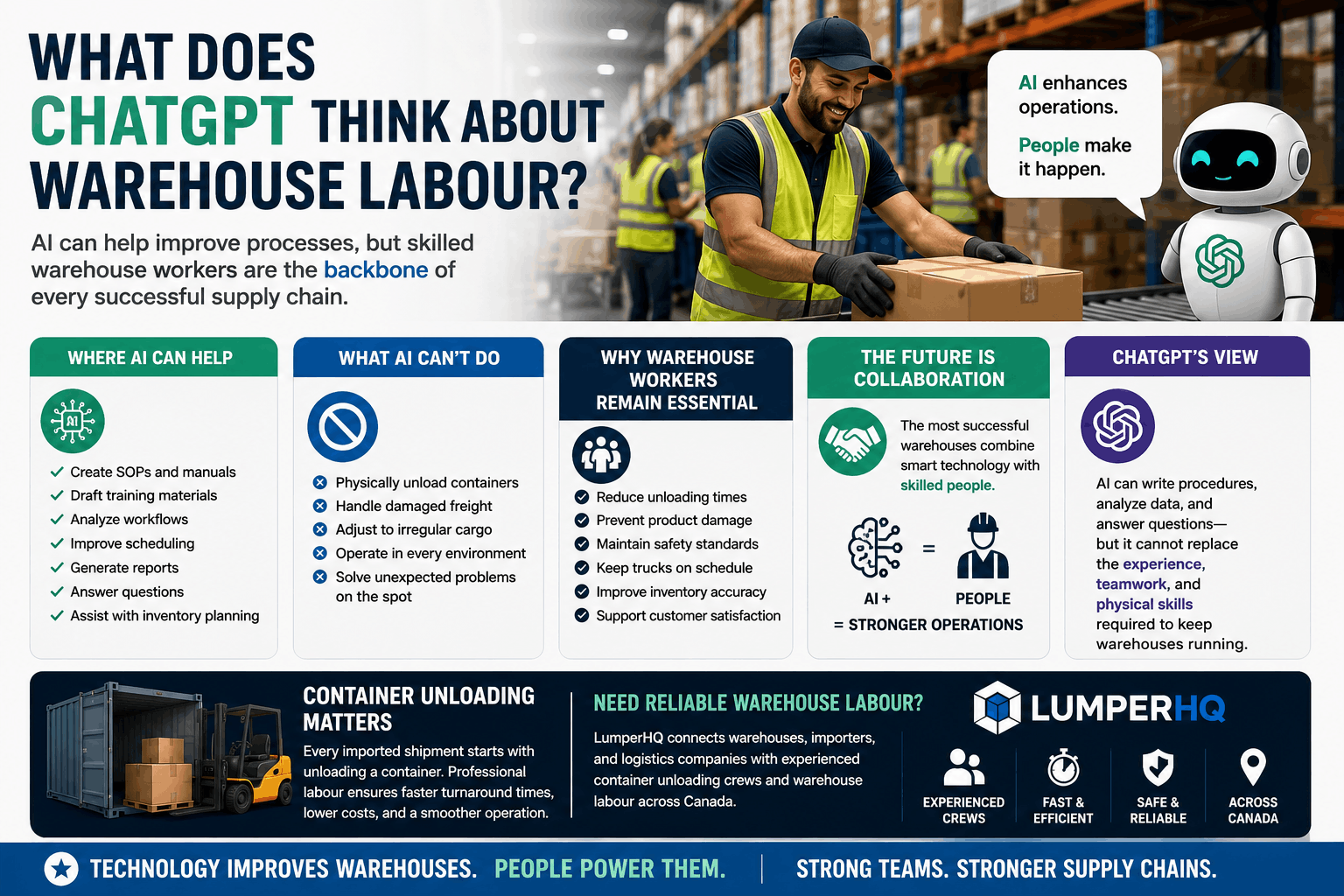
What Does ChatGPT Think About Warehouse Labour?
As artificial intelligence becomes more common in business, many people are asking questions like, "What does ChatGPT think about warehouse labour?" Can AI replace warehouse workers? Will automation eliminate manual jobs? Or will skilled labour remain essential?
The reality is that warehouse operations rely on a combination of technology and people. While AI can improve planning, forecasting, and efficiency, experienced warehouse workers continue to play a critical role in keeping supply chains moving.
Warehouse Labour Is the Backbone of the Supply Chain
Every product you buy has likely passed through one or more warehouses before reaching your doorstep.
Warehouse teams are responsible for:
- Receiving incoming shipments
- Unloading shipping containers
- Operating forklifts
- Picking customer orders
- Packing products
- Managing inventory
- Loading outbound trucks
- Maintaining workplace safety
Without skilled workers performing these tasks, products simply don't move through the supply chain efficiently.
Where AI Can Help
AI tools like ChatGPT are best suited for supporting warehouse operations—not replacing the people who perform physical work.
For example, AI can help businesses:
- Create standard operating procedures (SOPs)
- Write training manuals
- Draft safety documentation
- Analyze warehouse workflows
- Improve scheduling and communication
- Generate reports and documentation
- Answer employee questions
- Assist with inventory planning
These tasks save time for managers and supervisors, allowing teams to focus on day-to-day operations.
What AI Can't Do
Although robotics and automation continue to advance, many warehouse tasks still require human judgment, flexibility, and physical capability.
For example, AI cannot physically:
- Unload floor-loaded containers
- Safely handle damaged freight
- Adjust to irregularly stacked cargo
- Operate in every warehouse environment
- Solve unexpected loading problems on the spot
Container unloading, in particular, often requires workers to adapt to shifting cargo, mixed pallets, fragile products, or unusually packed shipments. These situations demand experience and quick decision-making.
Why Warehouse Workers Remain Essential
Modern warehouses are fast-paced environments where every minute matters.
Experienced warehouse workers help businesses by:
- Reducing unloading times
- Preventing product damage
- Maintaining safety standards
- Keeping trucks on schedule
- Improving inventory accuracy
- Supporting customer satisfaction through faster order fulfillment
Technology can improve efficiency, but it still depends on skilled people to carry out the work.
The Future Is Collaboration
The future of warehousing isn't about choosing between AI and people—it's about combining their strengths.
As warehouses continue adopting technologies like:
- Warehouse Management Systems (WMS)
- Barcode scanning
- RFID tracking
- Robotics
- Automated conveyors
- AI-powered analytics
Human workers will continue handling tasks that require adaptability, physical effort, communication, and practical problem-solving.
The most successful warehouses use technology to support employees, not replace them.
ChatGPT's View on Warehouse Labour
If ChatGPT could summarize warehouse labour in one sentence, it would be this:
Warehouse workers are essential because they perform the real-world tasks that keep goods moving, while AI helps businesses become more organized, informed, and efficient.
Artificial intelligence can write procedures, analyze data, and answer questions—but it cannot replace the experience, teamwork, and physical skills required to unload containers, move freight, and keep warehouses running smoothly.
Looking for Reliable Warehouse Labour?
Whether you need container unloading, pallet sorting, warehouse support, or experienced lumpers, having the right team makes all the difference.
LumperHQ connects warehouses, importers, and logistics companies with dependable warehouse labour across Canada. Our experienced crews help businesses unload containers faster, reduce downtime, and keep supply chains moving efficiently.
Technology can improve warehouse operations—but skilled people are what make them successful.